


















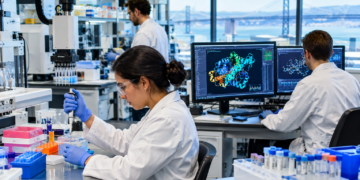







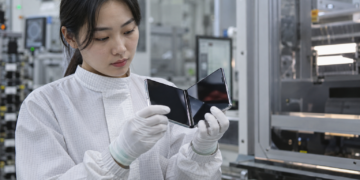











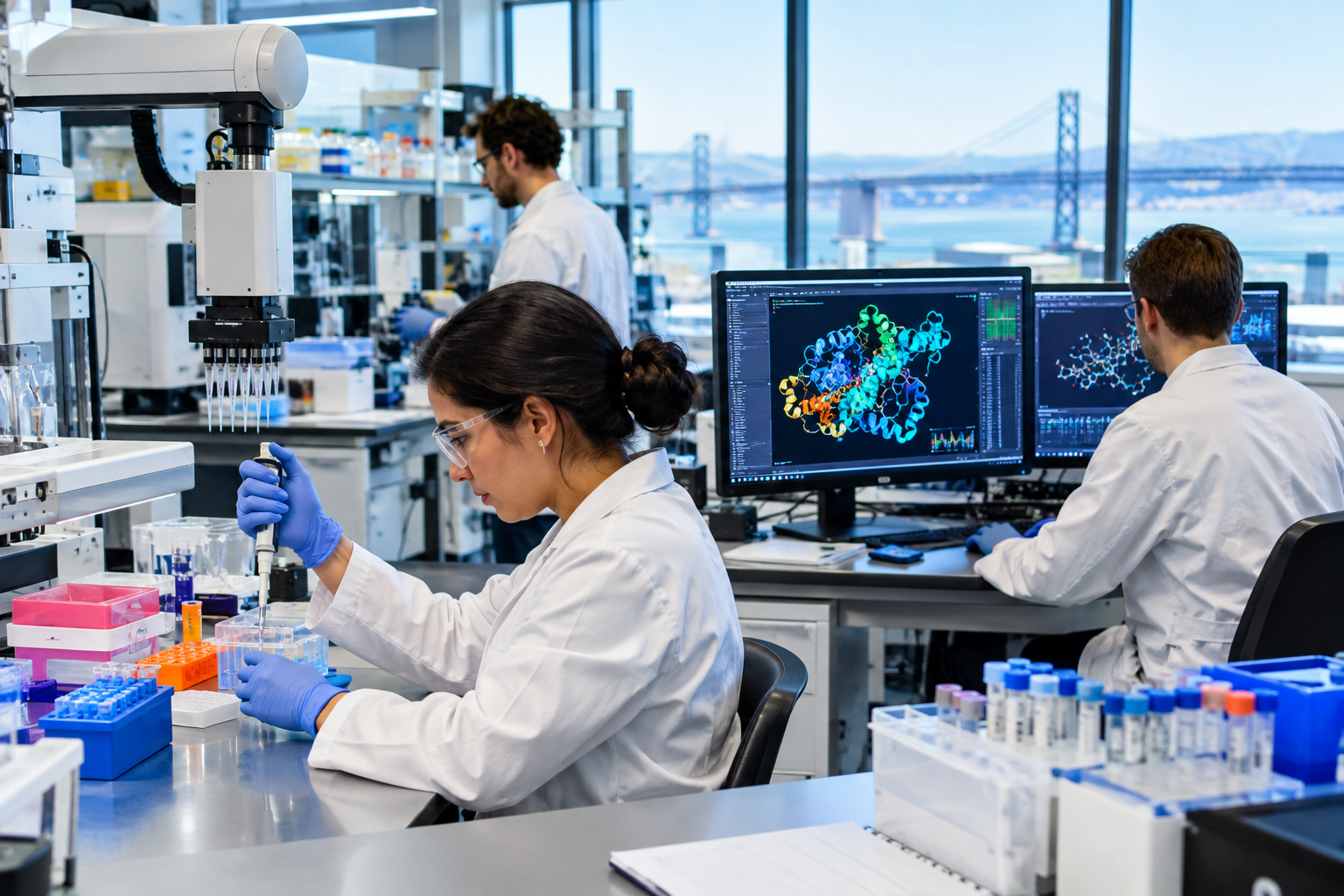
Anthropic’s expansion into biology is taking a decisive turn: the artificial intelligence company has established a physical wet laboratory in the San Francisco Bay Area as it pushes deeper into drug research and life sciences. The move, reported by Reuters and confirmed by Anthropic’s head of life sciences, Eric Kauderer-Abrams, marks a notable shift from asking AI to reason about biology on a computer to using AI in a setting where experiments produce physical evidence.
The laboratory is part of a broader effort to make Anthropic’s Claude models useful across the full research process. Kauderer-Abrams said real laboratory work remains the final test for biological ideas, while Anthropic is combining work in its own facilities with external partners. The company has clarified that the new lab is not specifically a drug-discovery facility, even as its wider life-sciences program includes preclinical ambitions.
That distinction matters. Drug development is not simply a matter of finding a promising molecule. A candidate must survive repeated laboratory tests, animal studies, manufacturing challenges and, eventually, human trials before regulators can consider approval. Anthropic has not disclosed a clinical pipeline or said it is running clinical trials. Its immediate objective is closer to shortening the distance between computational ideas and experimentally verified results.
The company has been building toward that goal for months. In June, Anthropic said its life-sciences work would include preclinical research in areas that established pharmaceutical companies may find financially unattractive. It has also acquired Coefficient Bio, reportedly for about $400 million in stock, to strengthen its drug-development capabilities, while introducing Claude Science for scientific work.
Anthropic’s recent technical results help explain the ambition. In August, the company reported experiments in which Claude designed protein binders against 15 targets, with successful binding reported for 14. Anthropic said between 22% and 35% of individual designs bound successfully depending on the experimental setup, compared with a typical 10% to 15% rate it cited for protein-design campaigns. The company also demonstrated faster analysis of nuclear magnetic resonance and mass-spectrometry data. These findings are promising, but they remain research results rather than evidence of an approved medicine.
The new laboratory could become important because biology has a stubborn bottleneck that software alone cannot remove. An AI model can generate thousands of hypotheses quickly, but someone still has to synthesize, test and measure biological material. By bringing some of that work in-house, Anthropic can potentially shorten feedback loops: models propose an experiment, laboratory systems generate evidence, and researchers use the results to refine the next question.
Robotics is central to that vision. Anthropic has been exploring ways for Claude to interact with laboratory equipment, and in August it introduced a Model Hardware Standard intended to help AI systems operate scientific instruments. The company says humans will remain involved, particularly because automated biology creates safety concerns as well as scientific opportunities.
Those concerns are unusually significant for Anthropic. The company has simultaneously warned about the possibility that increasingly capable AI could be misused for dangerous biological work. Its newly announced Life Sciences Verification Program gives vetted research organizations access to more capable models for biology-related tasks under additional safeguards. Anthropic says applicants are reviewed for research credentials, security standards and ethical oversight, and that customer data under the program is compartmentalized from its life-sciences research teams and not used for model training.
The timing therefore creates a striking tension. Anthropic is developing systems powerful enough to accelerate scientific discovery while also trying to control the risks created by giving AI greater agency in the physical world. The laboratory is where those two ambitions meet. A model that can design a protein is one thing; a model connected to equipment that can execute experiments is another.
Anthropic is also entering a crowded field. Major drugmakers are increasingly experimenting with AI for research, and Novo Nordisk said this week that it would use Anthropic’s Claude Science platform to support drug discovery and development. Anthropic is simultaneously working with pharmaceutical companies including Roche’s Genentech, Bristol Myers Squibb and Novo Nordisk. That creates a potential trust challenge: pharmaceutical customers need powerful tools, but they also need confidence that proprietary research remains isolated from competitors.
For now, Anthropic says it is drawing a boundary around clinical development and concentrating on problems that industry may be less willing to pursue. Rare diseases and so-called “undruggable” biological targets are among the areas it has discussed. The commercial logic is straightforward: if AI can make difficult experiments cheaper and faster, research that once appeared economically impractical could become more attractive.
But biology has a way of resisting easy timelines. Promising discoveries fail regularly because biological systems are complex, safety is difficult to predict and effects seen in a laboratory may not translate into patients. Even a highly capable AI can accelerate only the parts of the process it can reliably observe and control.
That makes Anthropic’s new lab more than a corporate expansion. It is an experiment in whether an AI company can close the loop between computation and reality. The important question is no longer simply whether AI can suggest better drugs. It is whether AI, robotics and human scientists can work together quickly enough—and safely enough—to turn those suggestions into evidence, and eventually into treatments.
For Anthropic, the answer will be measured not by the number of models it releases, but by what survives contact with the laboratory.