











































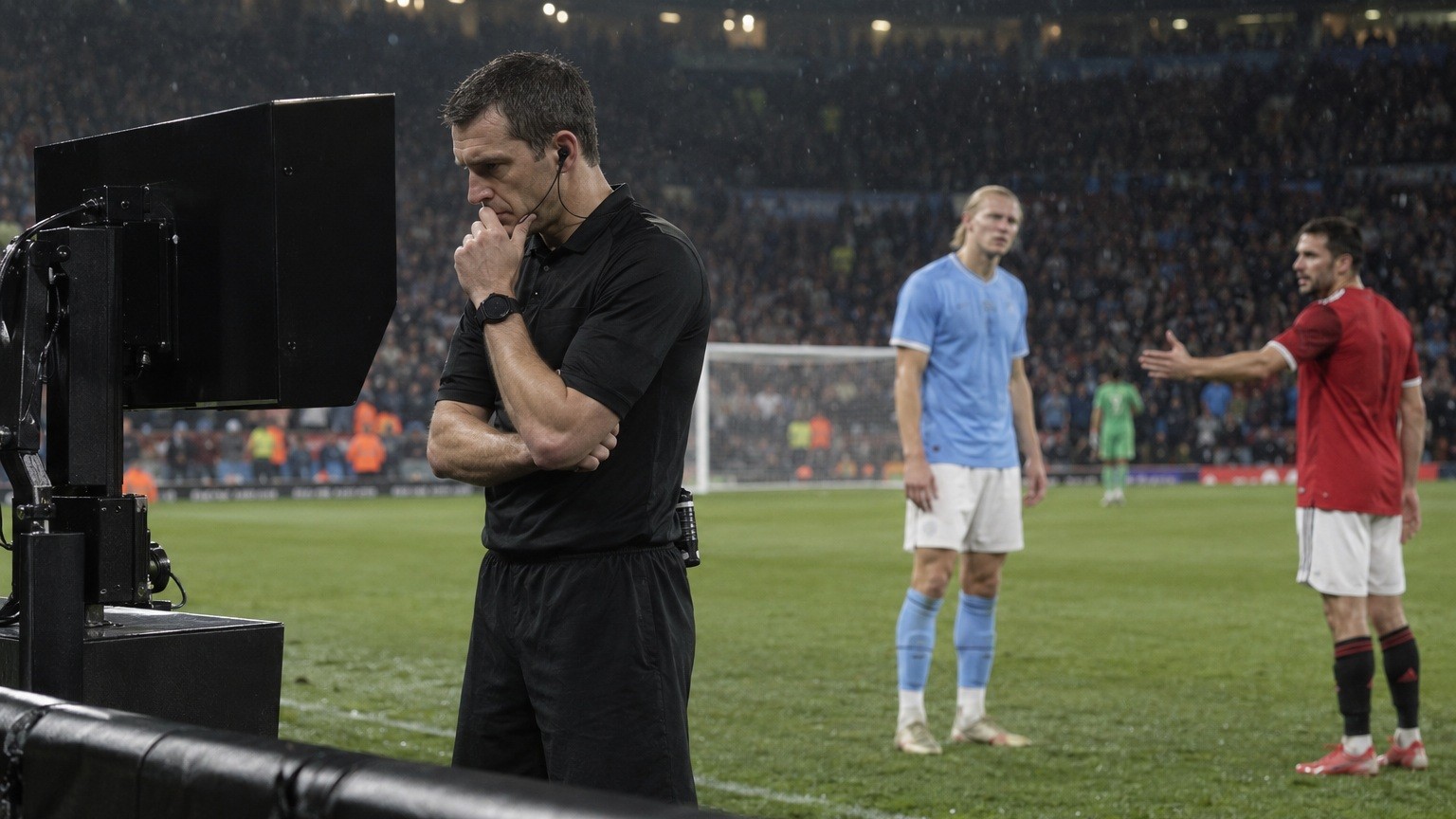
Pro Ref deserves a measure of credit for admitting that Erling Haaland’s winner at Old Trafford should not have stood. The apology came quickly, the mistake was described plainly, and Manchester United were contacted directly. Yet the honesty cannot restore a point, reopen the match or remove the suspicion that football’s most expensive safety net can still miss what everyone else can see. When an error decides a derby, transparency is the beginning of accountability, not its completion.
The disputed sequence was complicated only in the way modern officiating makes familiar football actions sound complicated. Haaland’s 60th-minute finish was initially ruled offside. VAR established that the striker himself was onside, but Enzo Fernández had attacked the same cross from an offside position. He did not touch the ball. He did, however, force Lisandro Martínez to react to his movement in front of goal. Pro Ref later accepted that the VAR failed to recognise Fernández’s likely impact and should have advised Michael Oliver to review the incident on the pitch-side monitor.
That distinction matters. Offside has never been limited to the player who applies the final touch. A forward can influence a defender’s decision, line of sight or ability to play the ball without appearing on the scoresheet. Martínez was not defending empty grass; he was responding to an opponent lunging toward the cross. To treat Fernández as scenery because he missed the ball is to misunderstand how defenders read danger in real time.
The episode also exposes a stubborn flaw in VAR culture. Technology is excellent at answering geometric questions: which shoulder was beyond which boot, and at what instant the pass was played. It is far less useful when officials mistake precision for understanding. The decisive question was not where Haaland stood. It was whether Fernández affected Martínez. That required football judgment, and the review room narrowed its attention until the larger action disappeared.
Michael Carrick’s anger was therefore understandable, even if United must resist turning the decision into an alibi. City played with ten men after Phil Foden’s 23rd-minute red card, yet United still failed to turn their numerical advantage into a goal. A poor call can alter a result while the losing team also bears responsibility for its own shortcomings. Both things can be true, and serious analysis should be able to hold them together.
City, meanwhile, should not be asked to apologise for accepting the goal. Players continue when the referee restarts play; clubs cannot referee their own matches. Haaland finished the chance placed before him. The institutional failure belongs to the process that overruled the assistant’s original decision without giving the on-field referee the best available look at the subjective part of the incident.
That is why the promised review must produce more than a private debrief and a quiet change of appointments. Pro Ref should explain which question the VAR asked, which replay angles were considered and why interference was dismissed. Releasing the relevant audio would let supporters hear whether the failure came from a rushed assumption, unclear protocol or simple tunnel vision. Public confidence grows when people can follow the reasoning, including the reasoning that went wrong.
The standard for intervention also needs clearer boundaries. VAR was introduced to correct clear mistakes, but this incident moved in the opposite direction: an on-field offside call was overturned after the objective check while the subjective offence inside the same action was left unresolved. When one review contains both measurement and interpretation, officials should be required to separate them aloud. Confirm the factual position, identify the possible interference, then send the referee to the monitor if judgment remains decisive.
Some will argue that another monitor visit adds delay to a sport already drowning in stoppages. That concern is fair, but speed has little value when the process reaches the wrong answer. The better solution is disciplined triage. Reviews should be shorter because the VAR defines the relevant questions early, not because a complicated phase is forced into a binary graphic about one player’s position.
Pro Ref’s admission will become meaningful only if it changes behaviour before the next disputed winner. Supporters can accept that referees are human. What they struggle to accept is a system built to provide a second look somehow producing a narrower view. The Manchester derby did not need perfect technology. It needed one official to recognise that a defender reacting to an offside attacker is evidence of involvement, then invite the referee to look again. Football saw the obvious. VAR, with every angle available, looked past it.