





























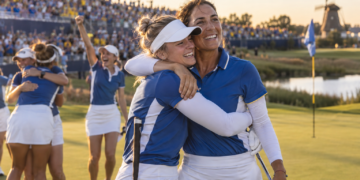







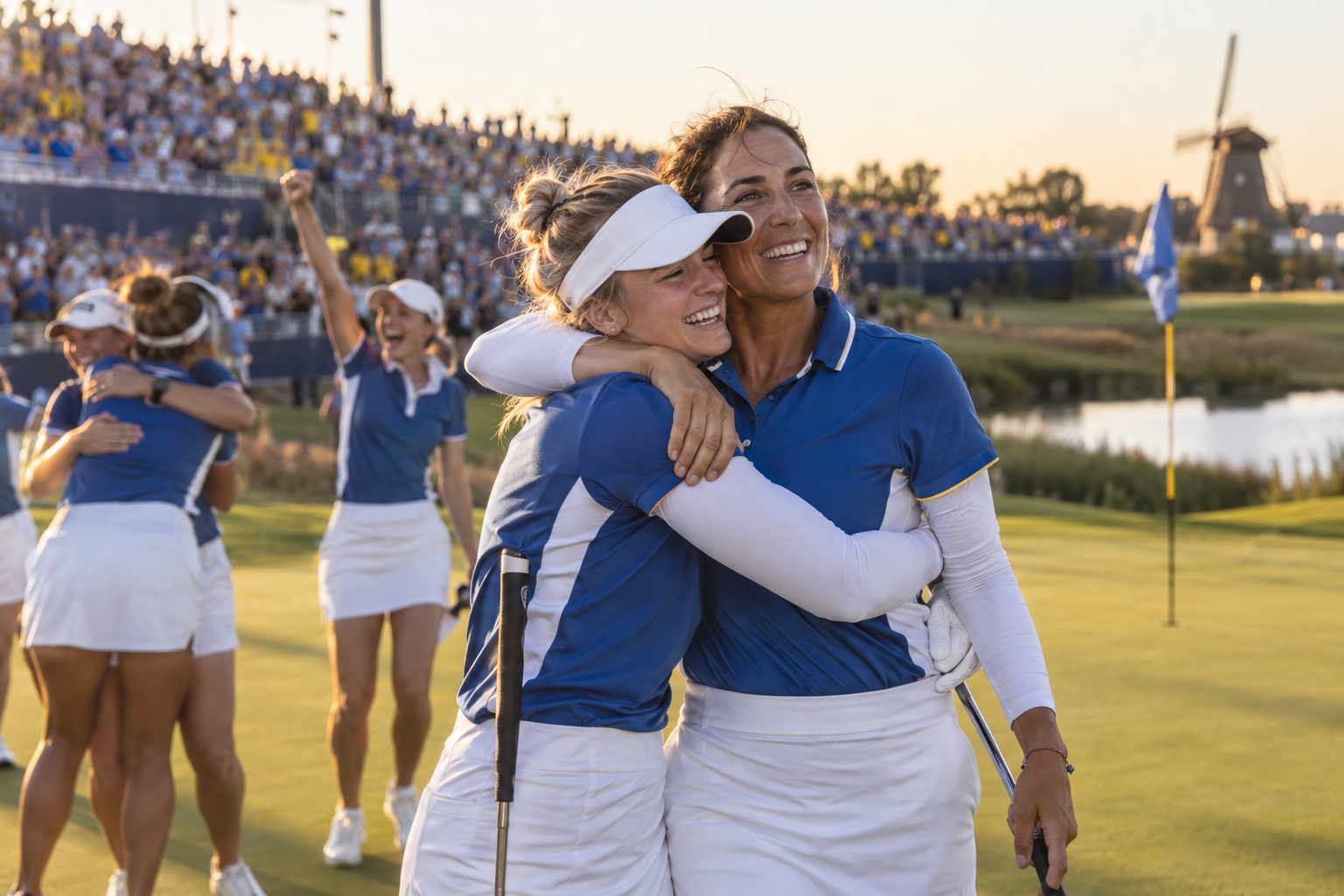
Europe did not simply win back the Solheim Cup at Bernardus; it recovered the most persuasive version of itself. The 15–13 score will sit neatly in the record book, yet the final Sunday felt gloriously untidy: momentum changing colour, putts shrinking or swelling under pressure, and a home crowd discovering that hope can be almost physically exhausting. Lottie Woad supplied the breakthrough and Carlota Ciganda applied the veteran seal. Together, they made Europe’s victory feel both immediate and enduring.
That combination matters. Team golf is often narrated as a contest between emotion and execution, as though players must choose one. Europe showed that its real advantage is the ability to make emotion useful. The noise at the Dutch course was not decoration around the competition; it became part of the team’s rhythm. Players walked faster after birdies, teammates appeared beside greens at exactly the right moments, and every patch of blue on the scoreboard seemed to enlarge the next player’s belief.
Sunday began at 8–8, the kind of symmetry that invites panic. Europe answered with clarity, winning six of the first eight singles matches and turning a level contest into a wave. That surge was not the work of one superstar carrying nervous colleagues. It was shared ownership, which is why the American fightback never quite became a full reversal. Alison Lee’s remarkable rally from four down against Esther Henseleit proved the United States still possessed courage, but Europe had built too many sources of resistance.
Woad’s point was the afternoon’s most revealing story. Her week had included difficult partnership sessions and a heavy Saturday foursomes defeat, the sort of experience that can make a young player tighten her swing and shorten her imagination. Instead, she met Auston Kim’s late run of three straight birdies with composure. Her two-foot putt on the 17th completed a 2-and-1 win and carried Europe beyond the winning threshold once Ciganda had guaranteed at least a half. Pressure did not disappear; Woad simply gave it somewhere productive to go.
There is an important lesson in that moment for captain Anna Nordqvist. Faith in a player is not sentimental when it is paired with responsibility. Woad was not protected from the sharp edges of the contest; she was trusted to return to them. Modern captains can overmanage match play, treating every pairing like a spreadsheet problem. Nordqvist’s Europe looked prepared without looking programmed. The players had roles, but they also had permission to respond as personalities rather than pieces.
Then came Ciganda, beating Jennifer Kupcho 4 and 2 and turning mathematical victory into emotional certainty. Some athletes appear to grow calmer when an event becomes louder, and Ciganda has made that quality her Solheim Cup signature. Her presence linked this young team to Europe’s recent history without trapping it there. Woad represented the future arriving early; Ciganda represented memory that still knows how to compete. Their closing points were not identical acts of heroism, and that is precisely why they belonged together.
The United States should not be reduced to a defeated supporting cast. Kim’s birdie sequence, Lee’s record comeback and the Americans’ Saturday resistance ensured Europe had to earn every celebration. That is good for the Solheim Cup. Rivalries become stale when one side’s identity depends on the other side collapsing. This edition offered something richer: an American team capable of producing danger and a European team capable of absorbing it. The tension survived because the quality did.
Europe’s 2024 defeat also gave this win its edge. Revenge is usually an overused sporting word, but recovery is not. The home side had to prove that its recent strength was more than nostalgia for earlier triumphs. At Bernardus, it did so through depth rather than mythology. The established names mattered, the rookies mattered, and the captain’s emotional intelligence mattered. Europe regained the trophy because its collective identity was broad enough to hold disappointment without allowing disappointment to define the next shot.
That is why the lasting image is not merely a putt dropping. It is Woad leaping toward teammates while Ciganda was still finishing her own work: celebration and concentration occupying the same few minutes. The scene captured what makes this competition different from ordinary tournament golf. A player can be alone over the ball yet never truly isolated. Europe brought the Solheim Cup home by making twelve individual burdens feel shared. In elite sport, that may be the rarest home advantage of all.