





































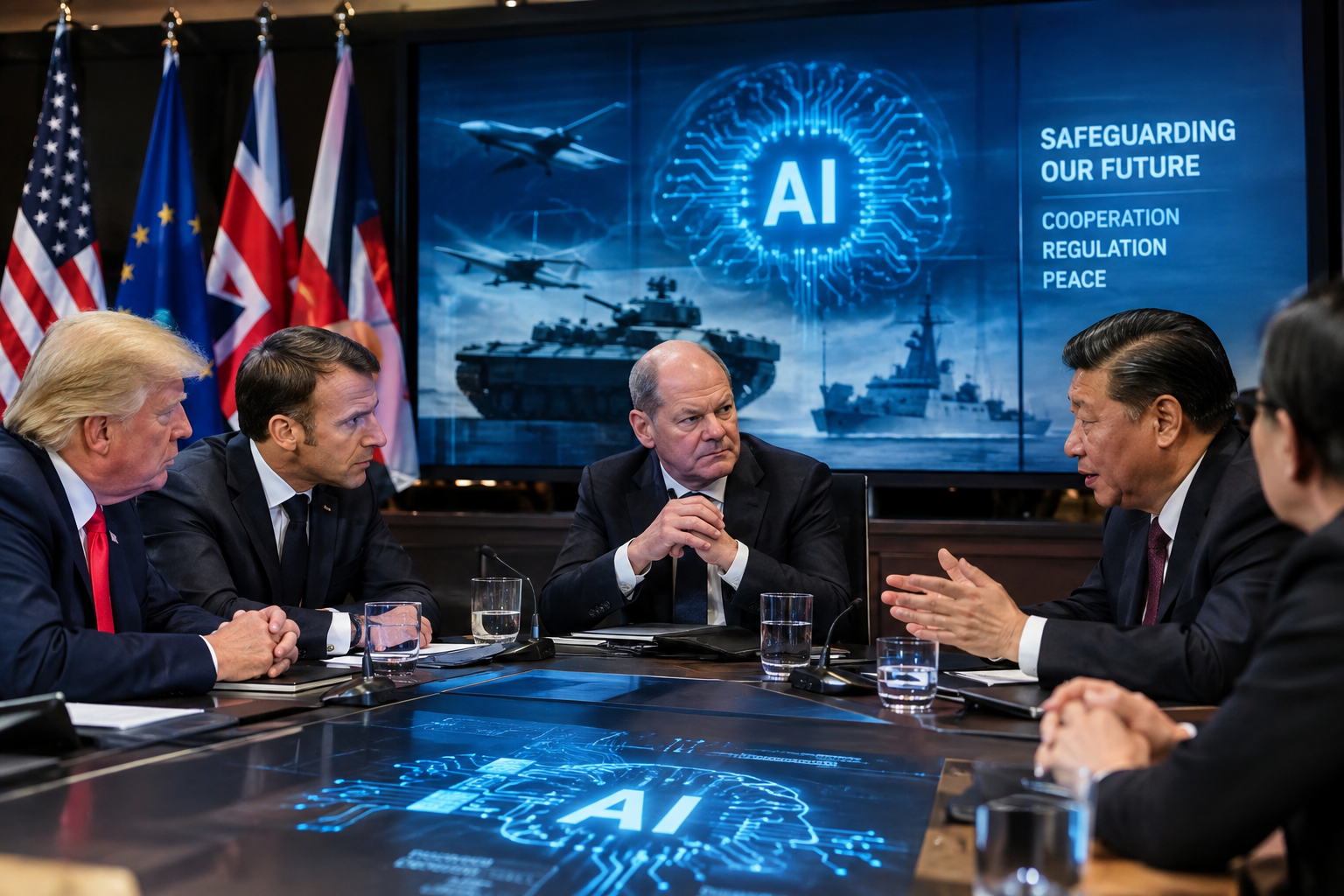
The race to build more capable artificial intelligence has increasingly become a race to turn intelligence into military advantage. Governments are investing in systems that can process battlefield information, identify targets, coordinate drones, defend networks and accelerate decisions. The central question is no longer whether AI will influence warfare, but whether countries can establish limits before competition makes restraint too costly.
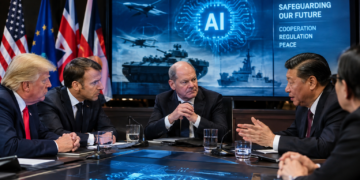
Recent developments have sharpened that question. U.S. and Chinese security experts have been discussing safeguards resembling Cold War-era arms control, including human oversight of critical military operations, restrictions around nuclear systems and direct communication channels for AI-related crises. Yet neither Washington nor Beijing has formally adopted such proposals, while both continue to view advanced AI as strategically important. Reuters reported this week that the two countries remain divided over technology controls, regulation and military applications even as their AI capabilities increasingly converge.
The military attraction is easy to understand. AI can examine enormous volumes of information much faster than human teams. It can help commanders detect patterns, prioritize threats and coordinate large numbers of machines. On a battlefield crowded with drones and electronic signals, the ability to make sense of information in seconds can be valuable.
Ukraine has provided a real-world demonstration of this transformation. AI-supported drones and other automated systems are being used alongside conventional weapons, while machine learning is increasingly involved in reconnaissance, target identification and battlefield management. The technology does not make war automatic, and it has important limitations. But it can compress the time between detecting a potential target and acting on that information, leaving less room for human review.
That acceleration creates one of the greatest dangers. A human commander may hesitate, seek additional information or recognize an unusual circumstance. An automated system may instead respond according to its programming and available data. If several countries deploy increasingly autonomous systems at the same time, a technical error, cyberattack or misinterpretation could escalate faster than political leaders can intervene.
The problem becomes even more serious when AI is connected to nuclear command, cyber operations or other systems where mistakes could have catastrophic consequences. A joint group of American and Chinese experts has therefore proposed clearer red lines and crisis communication mechanisms. The idea is not necessarily to stop military AI altogether, but to prevent the most dangerous applications from becoming part of an uncontrolled competition.
International law already provides an important foundation, but it was not designed specifically for today’s AI systems. The United Nations and International Committee of the Red Cross warned in August that autonomous weapons are advancing faster than international rules. They called for legally binding restrictions and emphasized the need to preserve human judgment and control over the use of force. Negotiations under the Convention on Certain Conventional Weapons have been underway for years, but geopolitical disagreements have slowed progress.
There is also a regulatory gap outside the battlefield. The European Union’s AI Act, for example, excludes systems used exclusively for military, defence or national-security purposes from its scope. That reflects the special role of national security in European law, but it also illustrates why military AI may require separate international rules rather than simply extending civilian AI regulation into defence.
Stopping the AI arms race completely may be unrealistic. Artificial intelligence is a general-purpose technology with civilian and military applications, and the same chips, software techniques and computing infrastructure can support both. A ban on “military AI” would therefore be difficult to define and even harder to verify. It could also create incentives for states to conceal capabilities rather than disclose them.
A more practical approach would focus on specific uses and safeguards. Countries could agree that machines must not independently make final decisions to kill people. They could establish testing requirements for autonomous systems, maintain auditable records of important decisions, require meaningful human supervision and create procedures for suspending systems that behave unexpectedly. Agreements could also prohibit AI from independently altering nuclear launch decisions or initiating strategic attacks.
Verification will be crucial. Arms control works best when governments can determine whether others are following the rules. That means technical standards, inspections where feasible, shared terminology and confidence-building measures. It could also mean reporting serious AI incidents in the same way countries report certain military accidents or nuclear events.
The economic consequences matter too. AI-enabled weapons could lower the cost of sophisticated military capability. Cheap autonomous drones, for example, could allow smaller states or non-state groups to acquire capabilities once associated with major powers. That could change deterrence, border security and the balance between offense and defence. At the same time, countries that spend heavily on AI may divert resources from conventional diplomacy and arms-control mechanisms precisely when those institutions are most needed.
There is another consequence that is less visible but equally important: responsibility. If an autonomous system causes unlawful harm, who is accountable—the commander, developer, manufacturer or government? If no person can clearly explain why a system selected a particular target, legal responsibility becomes harder to establish. Preserving a traceable chain of human responsibility is therefore not only an ethical issue but a practical requirement for international law.
The strongest opportunity for restraint may come before the technology becomes too deeply embedded in national military doctrines. The UN and ICRC are pressing governments to act while rules can still shape development. U.S. and Chinese experts are exploring mechanisms for avoiding catastrophic escalation. These efforts suggest that competition and cooperation do not have to be opposites.
The AI arms race is unlikely to end with a single treaty or a dramatic technological pause. A more realistic goal is to prevent competition from crossing particular thresholds: autonomous decisions over human life, uncontrolled escalation, interference with nuclear command and systems that cannot be reliably tested or understood.
Whether that can be achieved will depend less on stopping AI itself than on deciding where human authority must remain non-negotiable. The technology is advancing quickly. The rules governing its use will determine whether that progress becomes another instrument of deterrence—or a new source of instability.