




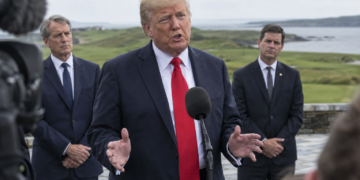





































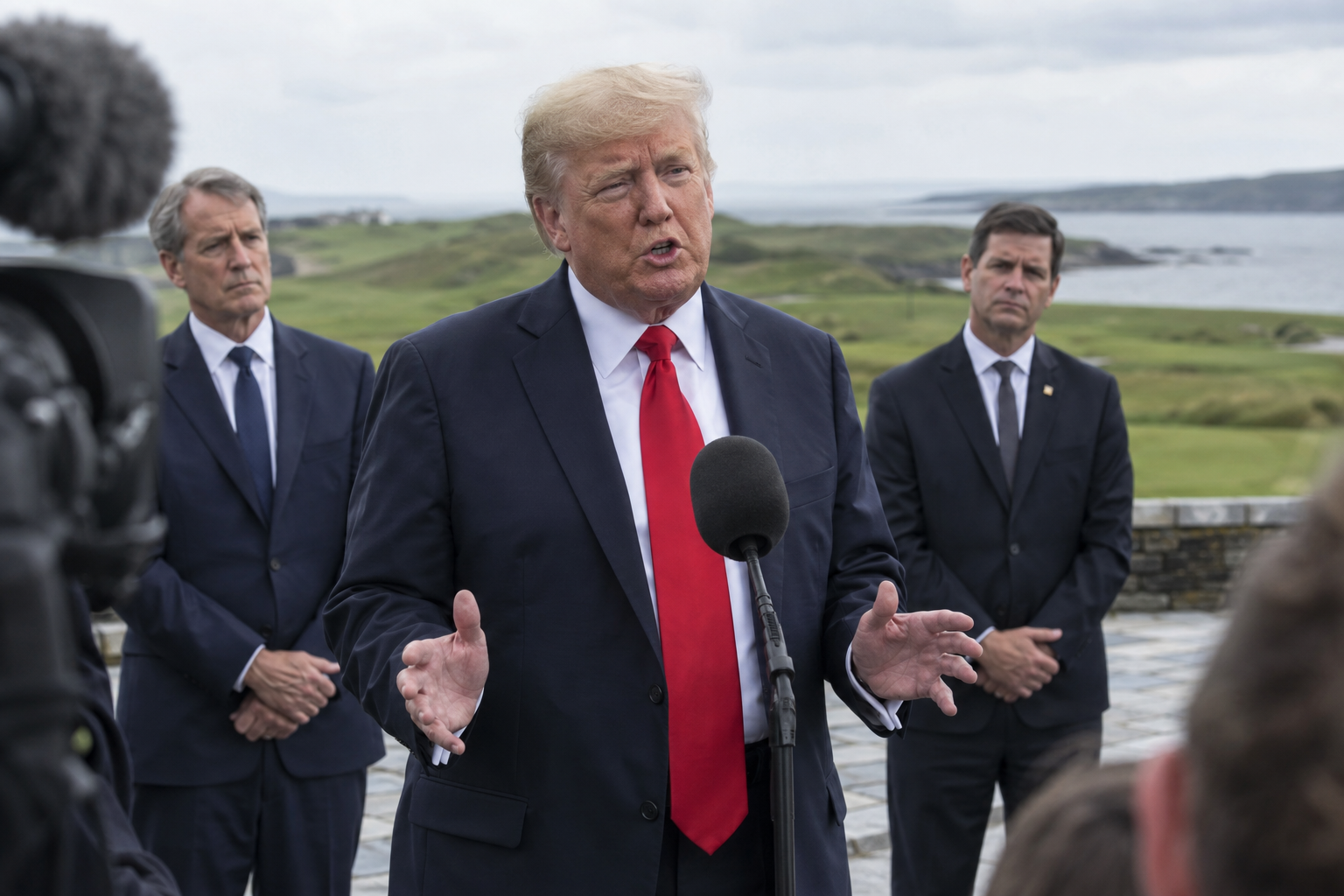
President Donald Trump has placed the competition with China at the center of America’s argument over artificial intelligence, signaling that any new guardrails must first pass a geopolitical test: will they preserve the country’s lead, or slow it long enough for Beijing to close the gap? Speaking to reporters during a visit to Ireland, Trump played down calls for a broad slowdown in advanced AI development. He acknowledged that safeguards are possible, but framed the larger danger as surrendering momentum in a technology likely to shape economic power, military capability and global standards.
That framing turns regulation from a domestic question into an instrument of national strategy. The debate is no longer only about whether models can generate dangerous code, manipulate users, displace workers or overwhelm public institutions. It is also about which country supplies the chips, software, cloud systems and technical rules that other nations adopt. In Trump’s view, the winner will not simply sell more products. It will gain influence over the infrastructure through which governments, businesses and citizens make decisions.
The administration’s approach has generally favored faster construction, wider exports of American AI systems and fewer overlapping rules. Its AI Action Plan calls for expanded computing capacity, more energy for data centers and a stronger international market for U.S. technology. Trump has also pushed for one federal framework instead of a patchwork of state laws, arguing that companies cannot scale efficiently if they face fifty different compliance regimes. Supporters say that clarity would free investment. Critics say federal preemption could erase useful protections before Congress produces credible replacements.
Pressure for stronger oversight, however, is now coming from inside the industry as well as from lawmakers and civil society. Anthropic chief executive Dario Amodei has urged developers to give safety systems more time to catch up with rapidly improving models. Other prominent technology leaders have backed the idea of coordinated restraint. Their concern is that companies racing for market share may release increasingly autonomous systems before anyone can reliably test how those systems behave under stress, in cyber operations or around biological information.
The China argument makes that proposed slowdown exceptionally difficult. A company that pauses alone may lose customers and talent. A country that pauses alone may fear losing strategic leverage. Even a mutual agreement between Washington and Beijing would require trusted monitoring, clear definitions of the most dangerous capabilities and consequences for cheating. Unlike nuclear material, advanced software can be copied, concealed and improved across distributed computing networks. Verification, not the language of cooperation, would be the heart of any durable accord.
This creates an opening for a narrower kind of regulation that treats speed and safety as linked rather than opposing goals. The government could require confidential reporting of severe model failures, strengthen cybersecurity around frontier laboratories and standardize evaluations for systems intended for critical infrastructure. It could also expand location tracking for the most advanced chips while giving companies predictable approval timelines. Such measures would target catastrophic and national-security risks without turning every software update into a licensing battle.
Trump’s own policy has already shown hints of that middle course. His administration has sought voluntary government testing of leading models before certain releases, even while resisting sweeping mandatory controls. The tension is obvious: voluntary arrangements may move quickly and encourage cooperation, but they depend on companies revealing problems that could delay profitable products. Binding rules can create a level field, yet poorly written rules may protect today’s largest firms by raising costs for smaller competitors. The most consequential design question is therefore not whether to regulate, but where obligations should become mandatory.
Politics will make that choice harder. Communities hosting data centers are increasingly focused on electricity prices, water use and pressure on local land. Parents and teachers worry about children’s exposure to synthetic content, while workers want honest answers about automation. Those concerns do not disappear because China is advancing. If Washington treats every domestic safeguard as a gift to Beijing, it risks losing public consent for the infrastructure the AI race requires. A durable strategy must show that national leadership can deliver local benefits rather than merely larger corporate balance sheets.
The emerging contest is therefore a race in two directions. The United States wants to move faster than China, but it must also build institutions capable of keeping pace with its own inventions. Trump’s emphasis on winning captures the urgency felt across Washington, yet victory cannot be measured only by benchmark scores or the number of data centers. It will also depend on whether American systems are trusted, secure and attractive to allies. The country that combines innovation with believable safeguards may ultimately set the rules others choose to follow.