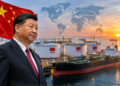








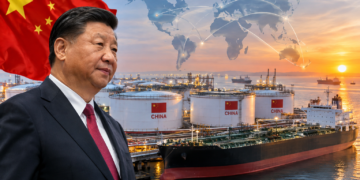






























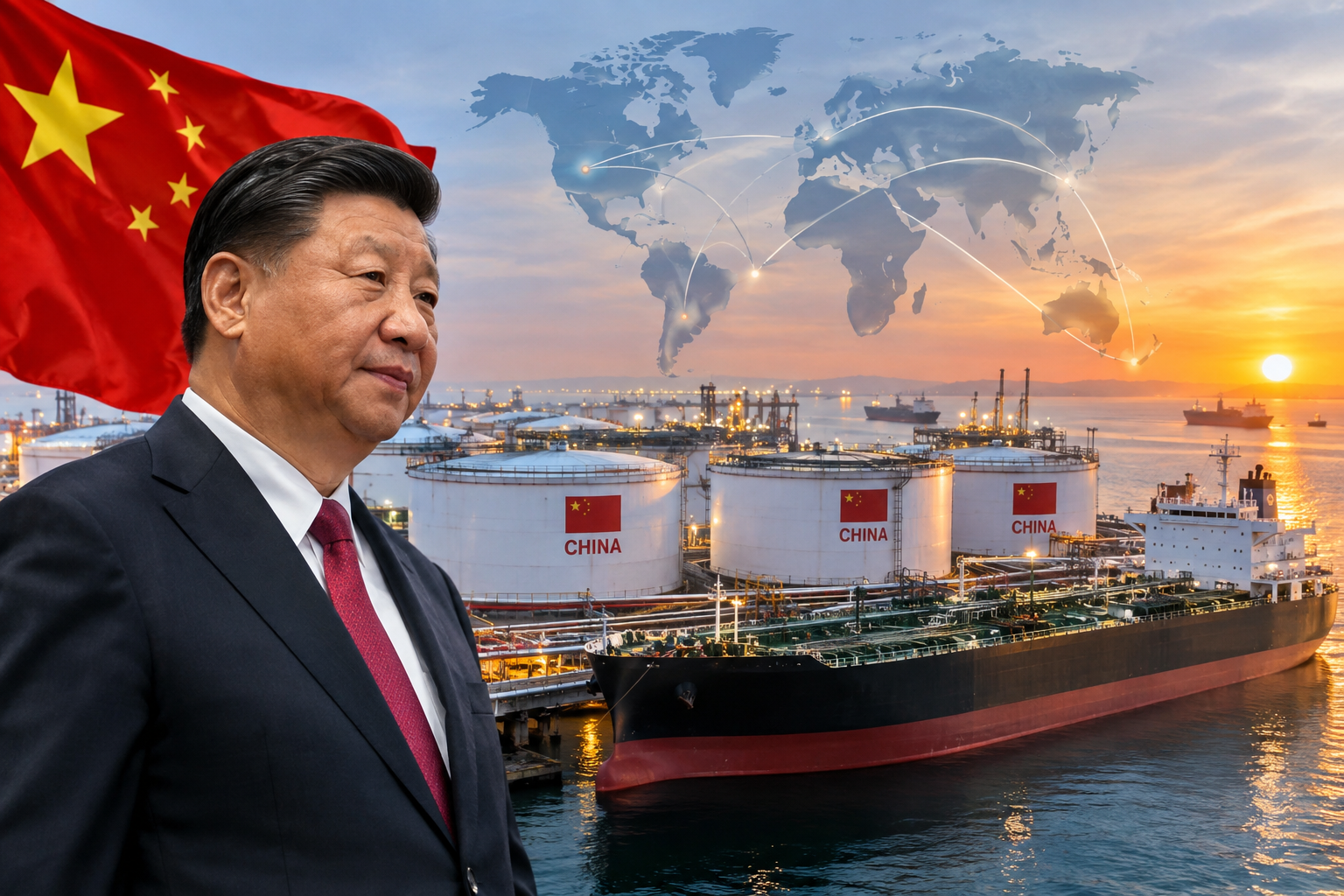
China’s years-long campaign to accumulate crude oil reserves is becoming more than a story about energy security. It is increasingly a factor that can influence prices, supply resilience and the balance of power in global oil markets. As geopolitical shocks expose the vulnerability of major shipping routes, Beijing’s large inventory provides a cushion at home while potentially giving China greater flexibility in deciding when and how aggressively to buy crude from abroad.
The scale of the stockpile is difficult to measure precisely because China does not publish a complete, transparent inventory figure. The U.S. Energy Information Administration estimated that China had nearly 1.4 billion barrels in strategic oil inventories at the end of 2025, including government and commercial stocks under its methodology. Government-held inventories were estimated at about 360 million barrels, while commercial crude inventories were around 1 billion barrels. That makes China’s storage system unusual: commercial tanks can effectively complement formal strategic reserves when authorities want to strengthen national supply security.
The buildup was especially significant in 2025. China imported a record annual average of about 11.6 million barrels of crude a day, while oil prices were relatively low. EIA estimates indicate that inventories increased by roughly 1.1 million barrels a day on average during 2025. In practical terms, China was not simply buying oil to run its refineries. A substantial share was being removed from the immediate international market and placed into storage, creating additional demand even when consumption growth was not equally strong.
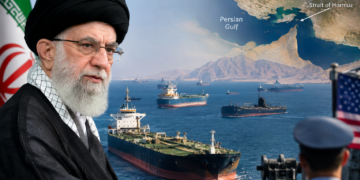
That strategy has now acquired a new importance. The disruption around the Strait of Hormuz and wider conflict in the Middle East have demonstrated how quickly an energy market can move from comfortable supply to severe uncertainty. In August 2026, China drew crude from inventories for the third time in four months as refinery processing exceeded the combination of imports and domestic production. Reuters estimated that onshore inventories stood at about 1.23 billion barrels on September 9, although the figure covers a broader stock category than official strategic reserves.
The immediate consequence is a form of insulation. When imported crude becomes exceptionally expensive or shipping routes are disrupted, Chinese refiners can rely on barrels already inside the country. That does not eliminate exposure to the global market, but it can delay the need to compete for scarce cargoes. During a prolonged disruption, such flexibility could matter for transportation, manufacturing, petrochemicals and electricity generation, particularly if refined-product shortages become more severe than crude shortages.
There is another, less obvious consequence: China’s stockpiling can change the behavior of the international oil market before a crisis even occurs. When Beijing buys large volumes for storage, exporters gain a major customer and global inventories fall faster than underlying consumption alone would suggest. EIA said China’s strategic purchases supported crude prices in 2025 because the barrels taken into storage acted as a source of demand. Conversely, when China stops buying or begins drawing down stocks, the market loses an important source of incremental demand.
This gives Beijing influence without requiring it to control oil-producing countries. A large inventory can function as a financial and strategic option. China can buy aggressively when prices are weak, reduce purchases when prices are high, and release stored crude when domestic supply conditions demand it. The effect is not equivalent to controlling global prices—the international market remains shaped by producers, consumers, shipping capacity, sanctions and geopolitical events—but China’s inventory decisions can increasingly become part of that equation.
The strategy also changes China’s relationship with oil-producing states. China remains heavily dependent on imported crude despite rising domestic production, making long-term relationships with Middle Eastern, Russian and other suppliers important. Its purchasing power is particularly significant for producers facing sanctions or restricted access to Western markets. At the same time, large storage capacity allows Chinese companies to negotiate from a stronger position because they are less compelled to buy every cargo immediately.
Yet stockpiling has limits. Oil reserves are not the same as energy independence. Storage cannot indefinitely compensate for a prolonged interruption of imports, and crude still has to be transported, refined and distributed. China’s second-quarter 2026 crude imports fell to about 8.1 million barrels a day, according to EIA, after higher prices and disrupted flows through the Strait of Hormuz. The decline showed both the value of inventories and the pressure that a major supply shock can place on Chinese industry.
There is also a financial risk. Holding enormous volumes of crude ties up capital and exposes state companies and refiners to changes in oil prices. Buying cheaply can prove advantageous, but purchases made near market peaks can produce losses if prices later fall. Storage capacity itself also requires infrastructure, maintenance and security. In addition, an oil strategy built around large reserves must coexist with China’s expanding electric vehicles, renewable power, nuclear capacity and other efforts to reduce dependence on fossil fuels.
For other major oil-consuming countries, China’s stockpile is a reminder that energy security is increasingly about storage as well as production. Japan, South Korea, the United States and European countries maintain substantial reserves, but their systems differ in ownership, transparency and purpose. China’s combination of government stocks, state-owned companies and commercial inventories creates a particularly broad buffer, although the lack of complete public data makes direct comparisons uncertain.
The broader consequence may be a gradual shift in how oil markets respond to crises. In the past, a disruption could immediately translate into a scramble for physical barrels. A country with deep reserves can instead absorb part of the shock internally. If China continues building inventories when prices are favorable, it could become less sensitive to short-term supply interruptions while becoming more important to producers during periods of weak demand.
That does not mean China has secured permanent dominance of the energy landscape. Oil remains a global commodity, and the country still faces exposure to maritime chokepoints, sanctions, foreign suppliers and refinery economics. But the accumulation of crude has created a strategic buffer large enough to influence market expectations. The real significance of China’s stockpile may therefore lie not in how many barrels are buried in tanks, but in the choices those barrels allow Beijing to make when the next energy shock arrives.