
































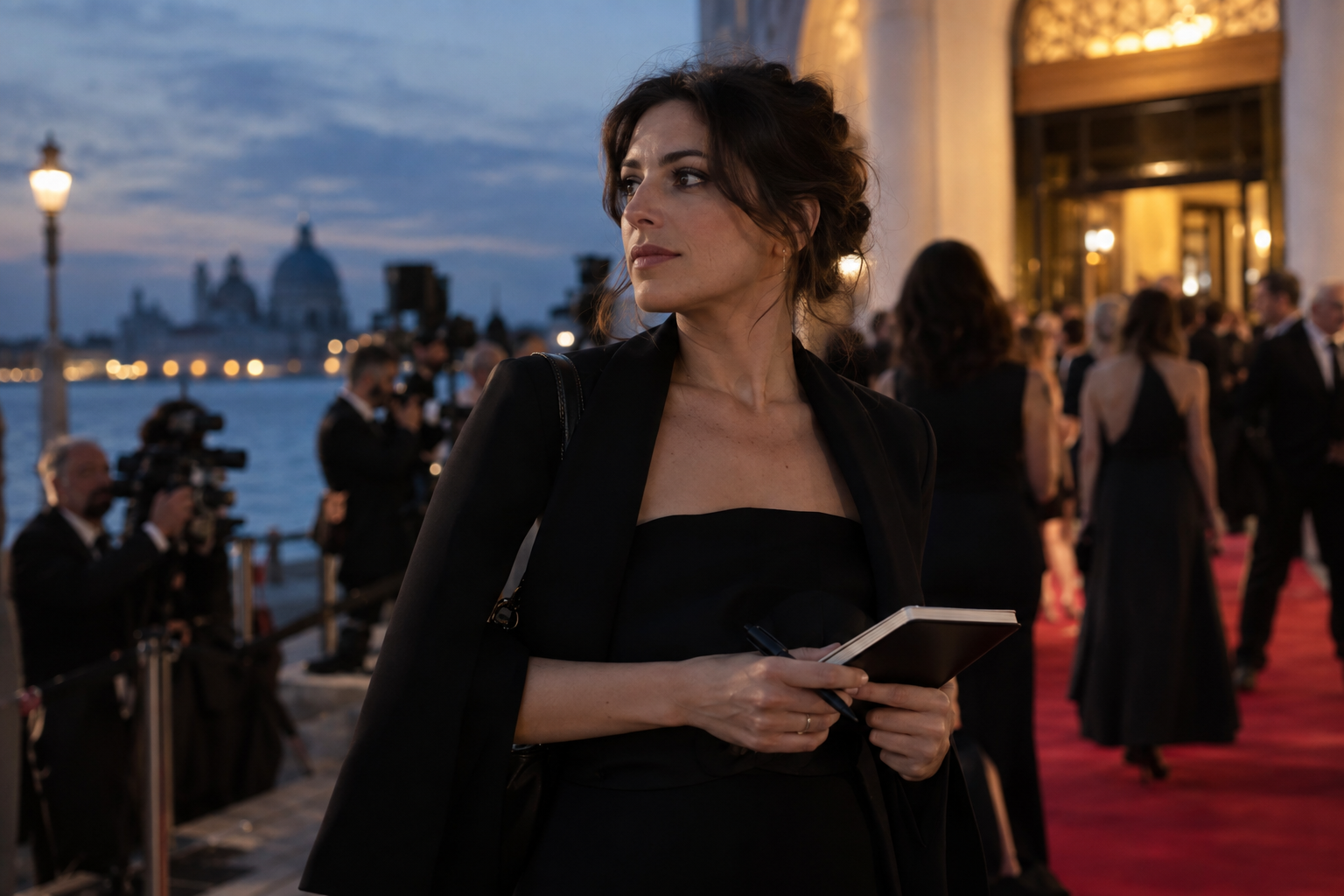
Venice has always sold the romance of prediction: one ecstatic premiere, one tearful ovation, and suddenly an Oscar campaign appears to have found its destiny. The 2026 festival complicated that familiar story. Its most convincing contenders did not arrive in a single prestige package. They came as a queasy television satire, a postwar melodrama, a Korean class study, a political tragicomedy, an investigative documentary and a 22-minute reverie about Marilyn Monroe. That unruly range is precisely why this year’s Lido discoveries feel alive.
Primetime is the obvious conversation starter. Lance Oppenheim’s fiction debut revisits the rise of To Catch a Predator, with Robert Pattinson playing host Chris Hansen as a man slowly intoxicated by his own moral authority. The film’s subject could have produced an easy sermon about reality television. Instead, its friction lies in the way public service, punishment and showmanship become impossible to separate. Pattinson’s performance is the strongest Oscar hook, but the sharper achievement may be the film’s uneasy refusal to tell viewers where concern ends and appetite begins.
Woman Unknown leaves Venice with the most useful prize an awards campaign can carry: the Golden Lion. May el-Toukhy’s drama, set in Denmark after the Second World War, follows Marie, a working-class housemaid whose chance at security is threatened by secrets from the occupation. Mathilde Arcel, also awarded the Volpi Cup, gives the film its pulse. Her restraint makes every judgment imposed on Marie feel physical. Academy voters often respond to historical drama, but this one deserves attention because it distrusts the tidy moral distance that period settings can provide.
Possible Love may require more patience from voters, and I mean that as praise. Lee Chang-dong studies two Korean couples divided by money, taste and opportunity, allowing envy to move through dinners, interviews and private humiliations. The Silver Lion Grand Jury Prize gives the film stature; Jeon Do-yeon gives it heat. In a season that will reward louder transformations, her work offers the rarer pleasure of watching dissatisfaction gather behind a composed face. Best Actress and international-feature conversations should make room for that kind of precision.
Wild Horse Nine has a more familiar awards engine: Martin McDonagh’s dialogue, a large ensemble and John Malkovich in late-career command. Set against the shadow of the 1973 Chilean coup, the film sends Malkovich and Sam Rockwell into a violent, absurd CIA mission. Malkovich’s Venice acting win will push him to the front of the campaign, yet the film’s real advantage is tonal risk. McDonagh lets comedy expose the vanity of imperial power rather than soften its consequences. That is a difficult balance, and actors are likely to admire the nerve required to hold it.
NAZA enters a different, more combustible race. Yuval Abraham and Rachel Szor’s documentary uses testimony from members of Israeli military intelligence to examine surveillance, targeting and civilian deaths in Gaza. It won Venice’s Special Jury Prize after a reception that made indifference seem impossible. Its Oscar path will involve political resistance, questions of eligibility and an exceptionally crowded documentary field. Still, the film’s controlled form matters. By refusing the emotional instructions of a conventional polemic, it makes testimony carry the burden. Voters may debate it fiercely; they will struggle to dismiss it.
Then there is Flesh Impact, Maggie Gyllenhaal’s out-of-competition short, which imagines Marilyn Monroe across time through Dakota Johnson and Ellen Burstyn. The premise risks becoming commemorative perfume. Gyllenhaal instead treats Monroe’s famous accessibility as a wound: the camera made her feel touchable, and the culture took that invitation literally. Burstyn, playing the older woman Monroe never became, supplies the image that lingers. If the film clears the Academy’s qualifying requirements, its stars and compact emotional design could make it formidable in the live-action short race.
These six films do not form a neat forecast. Some have distributors and prizes; others still need the unglamorous machinery of qualifying runs, category strategy and sustained campaigning. Nor should Venice applause be mistaken for Academy votes. What they share is more valuable than early certainty. Each understands that visibility has a cost, whether the spectacle is a television sting, public shame, private wealth, state power, war reporting or the manufacture of a screen goddess.
My early bet is that Woman Unknown travels furthest as a film, while Pattinson, Arcel and Malkovich give voters the clearest individual performances to rally around. Yet Flesh Impact may hold the purest distillation of Venice 2026: glamour viewed from the bruised side of the lens. The festival’s best Oscar hopefuls are compelling because they make attention itself the subject—and leave us wondering what our gaze demands from the people caught inside it.