

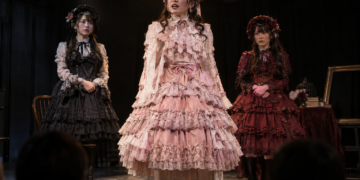






































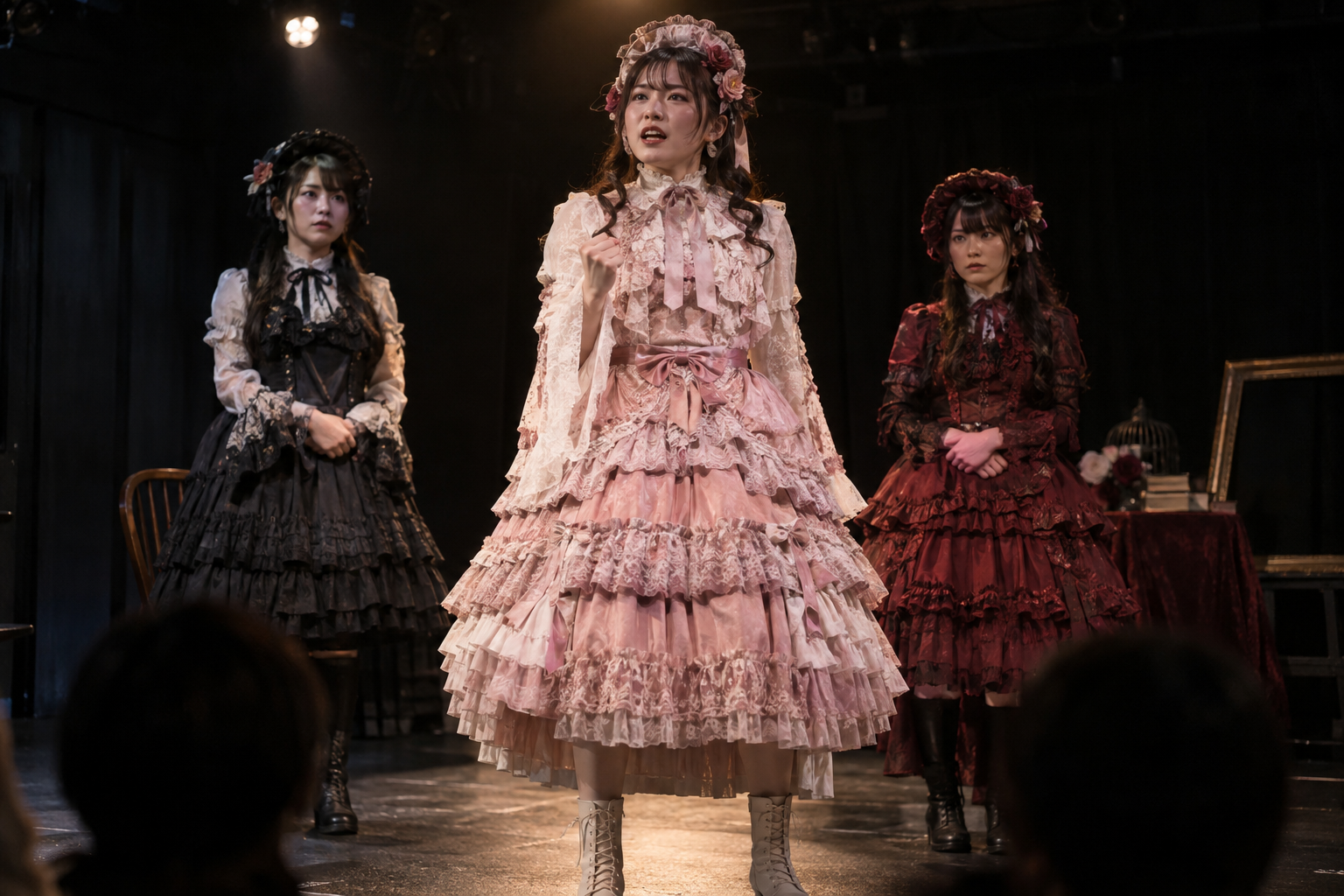
Under the warm lights of a small Tokyo theater, the first thing the audience notices is softness: tiers of lace, satin bows, bonnet ribbons and bell-shaped skirts in pink, white and black. Then the screaming begins. The women of TremendousCircus do not whisper their anger about rape, harassment and the demands placed on women. They hurl it across the stage, turning a style often dismissed as decorative into a loud, physical refusal to behave.
The troupe calls itself a radical feminist theater company. Formed in Tokyo in 2016, it builds musicals around the experiences of women who have survived sexual violence and other forms of abuse. Its members treat Gothic and Lolita fashion as formal dress and armor. The choice is theatrical, but it is also an argument: femininity does not have to be surrendered before a woman can resist the rules imposed on her.
That argument drove a recent production, “UNITE,” in which nine performers played revolutionaries confronting an artificial-intelligence dictator named Big Father. The dystopian frame was deliberately oversized, yet the script drew power from intimate material. TremendousCircus says the work was shaped by autobiographical accounts from performers and supporters. Private memories of control, dependence and violence became public speech, backed by dark music and a visual world that looked like a fairy tale after midnight.
For co-founder Chino, 28, the stage offers a way to imagine life beyond the assault she survived. Her ambition is not to remain trapped in the role of victim, but to show other survivors that pleasure, beauty and curiosity can return. In that sense, the dresses do more than contradict the fury of the dialogue. They insist that recovery may include the right to enjoy what was once judged childish, frivolous or designed only for male approval.
Performer Hina Haruka, 27, carries the same idea into the streets of Harajuku, where she wears layered Gothic Lolita clothes even in fierce summer heat. She has described the tightly fastened garments as a form of protection because they cannot be removed quickly. That is her personal interpretation rather than a general safety prescription. More broadly, the layers give her control over how her body is presented: the silhouette occupies space while refusing the revealing fit that strangers may expect.
This is where TremendousCircus makes its sharpest intervention. Kawaii culture is frequently associated with sweetness, youth and harmlessness. The troupe keeps the sweetness but removes the obedience. Lace becomes confrontational because the women wearing it decide what it means. Cuteness is no longer a request to be liked; it becomes a vocabulary for anger, solidarity and self-possession. The audience must hold both images at once, and the tension makes familiar assumptions suddenly visible.
The company also turns inequality into a practical provocation at the box office. For some performances, men pay substantially more than women, while one scheduled show was reserved for women. The pricing echoes Japan’s persistent gender pay gap by briefly reversing who bears the premium. It may unsettle spectators, and that is part of the point. TremendousCircus is less interested in neutral cultural consumption than in creating a room where women can speak without adjusting every sentence for male comfort.
Its approach sits inside a country still struggling with gender inequality and underreporting of sexual abuse. A 2024 Japanese government survey found that roughly one in ten young people had experienced groping, with women forming the large majority of victims. Public conversations have grown, but shame, professional risk and fear of disbelief continue to shape whether survivors speak. Onstage, testimony gains distance through character and fantasy without losing its source in lived experience.
The result can be abrasive. In “UNITE,” performers tore up fabricated images of men and imagined violent rebellion. Such scenes will not persuade every viewer, nor are they meant to offer a tidy policy program. Their value lies in making anger legible in a culture that often rewards women for absorbing discomfort quietly. The production gives rage choreography, costumes and a chorus, then lets an audience decide what to do with the unease.
When the three-hour show ended, many women in the audience were crying as well as smiling. That response points to the troupe’s larger project. TremendousCircus does not use fashion to soften its politics. It uses beauty to hold attention long enough for difficult testimony to be heard. In a theater filled with ribbons and heavy skirts, cuteness does not cancel fury. It gives fury a shape of its own choosing.