




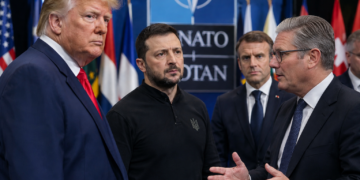
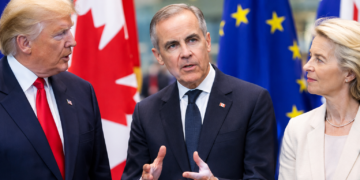



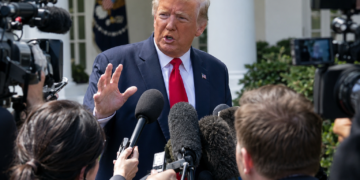












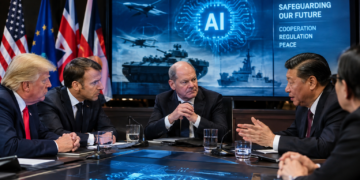
























For decades, Europe’s security architecture rested on a simple bargain: the United States supplied much of the military weight, while European allies contributed forces, bases, money and political support. Donald Trump has spent years arguing that the balance is unfair. In his second presidency, that pressure has moved from campaign rhetoric into a force shaping decisions about budgets, procurement, troop deployments and the future of NATO itself.
The result is a paradox. Trump’s confrontational approach has increased the urgency of European rearmament while simultaneously raising questions about the reliability of the American security guarantee. Rather than immediately breaking NATO apart, the pressure is pushing European governments to prepare for a future in which they may have to carry substantially more of the conventional defense burden.
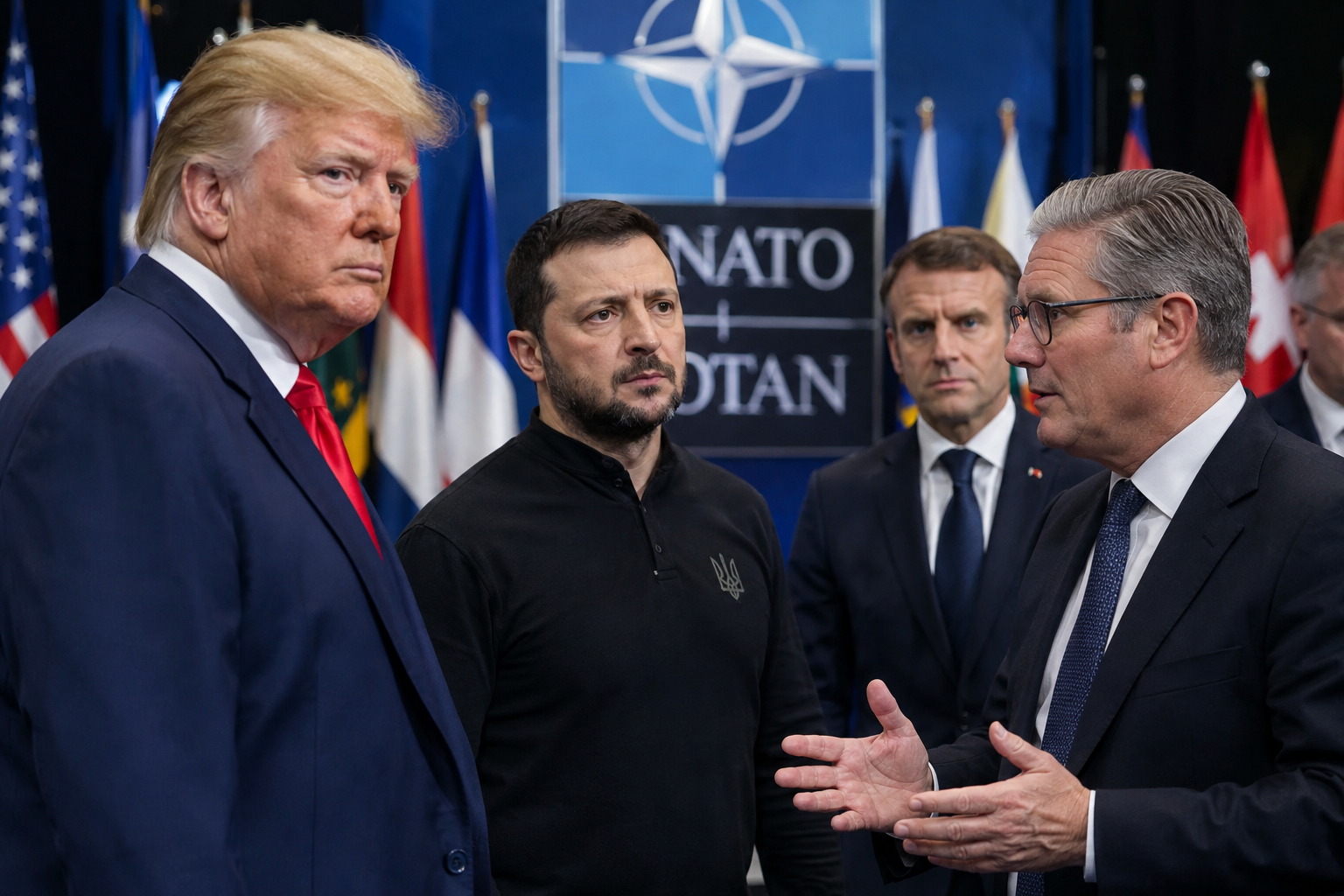
At the 2025 NATO summit in The Hague, all allies agreed to a new target of spending 5% of gross domestic product annually on defense and defense-related security by 2035. At least 3.5% is intended for core military requirements, while up to 1.5% can cover areas including infrastructure, cyber defense, resilience and industrial capacity. NATO says European allies and Canada increased defense expenditure by nearly 20% in real terms in 2025 compared with 2024. These figures show that the argument over burden sharing has already translated into concrete policy.
Yet spending more is only the beginning. European militaries face gaps in air and missile defense, ammunition stocks, long-range weapons, logistics, drones, intelligence and military mobility. The war in Ukraine has demonstrated how quickly modern warfare consumes ammunition and equipment, while inexpensive drones can create expensive defensive problems. European governments therefore face a difficult task: transform larger budgets into usable capabilities without duplicating one another or wasting years on fragmented procurement programs.
That challenge is encouraging a second transformation: Europe is becoming more interested in its own defense-industrial base. Germany, Poland, France, the United Kingdom and other countries are expanding production or pursuing multinational programs, while governments are looking more closely at European suppliers. This does not mean abandoning American weapons. The United States remains deeply embedded in NATO’s command structure, intelligence systems, nuclear deterrence and advanced military technology. But European officials increasingly want alternatives when political uncertainty makes dependence look risky.
The question of American troops is even more consequential. The Trump administration is conducting a review of the U.S. military presence in Europe, with Reuters reporting that one proposal could reduce the roughly 80,000 American troops stationed on the continent by about 25,000. Any substantial reduction would not automatically end NATO’s security commitments, but it would force European countries to reconsider how quickly they can replace capabilities that American forces currently provide, particularly in intelligence, airpower, logistics and strategic lift.
For countries closest to Russia, the stakes are particularly high. Poland and the Baltic states have treated NATO’s eastern flank as a central security concern, while recent drone and other airspace incidents have reinforced fears that Russia could test the alliance below the threshold of a conventional war. NATO has been adapting its defenses toward a broader approach covering aircraft, drones, missiles, cyber threats and other forms of pressure. The central issue is not simply how many soldiers Europe has, but whether the alliance can detect a crisis early and respond quickly enough to prevent escalation.
At the same time, greater European defense autonomy could strengthen NATO rather than weaken it. A Europe that can field more troops, ammunition, air defenses and industrial capacity would reduce the imbalance that has frustrated successive American administrations. It could also allow the United States to concentrate more on challenges outside Europe without leaving allies exposed. NATO’s 2025 spending agreement was explicitly framed as a stronger and fairer transatlantic arrangement, suggesting that burden sharing and alliance cohesion are not necessarily opposing goals.
But the political risks are real. Trust is an essential military capability because deterrence depends partly on an adversary believing that allies will act together in a crisis. Repeated uncertainty about American commitments can encourage European governments to hedge, while visible disagreement among allies can encourage Russia to test their resolve. Conversely, European demands for greater autonomy can be interpreted in Washington as evidence that allies are drifting away from the alliance. A cycle of suspicion could therefore become more dangerous than any single budget dispute.
There is also a domestic price. Moving toward 5% of GDP requires governments to make choices among defense, welfare, infrastructure, taxation and debt reduction. The political challenge will become sharper as the spending target moves from summit declarations into annual budgets. Some countries will advance faster than others, and disagreements over what counts as defense-related spending could become a recurring source of tension.
The future of NATO may therefore depend less on whether Europe becomes more independent from Washington and more on whether the alliance can turn that independence into complementary strength. Europe can assume more responsibility while remaining inside a transatlantic framework, provided that military planning, intelligence, command structures and procurement remain coordinated. The United States, meanwhile, can demand greater European contributions without making uncertainty itself the organizing principle of allied defense.
Trump’s pressure has already changed the conversation. European defense is no longer treated as a secondary budget issue but as a central strategic requirement. Whether that produces a more capable NATO or a looser collection of national and regional defense arrangements will depend on decisions made over the next several years. The alliance is being tested not only by Russia and other external threats, but by a fundamental question about responsibility: how much security can Europe provide for itself, and how much must still depend on America?