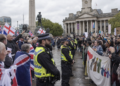
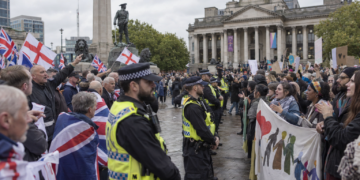



































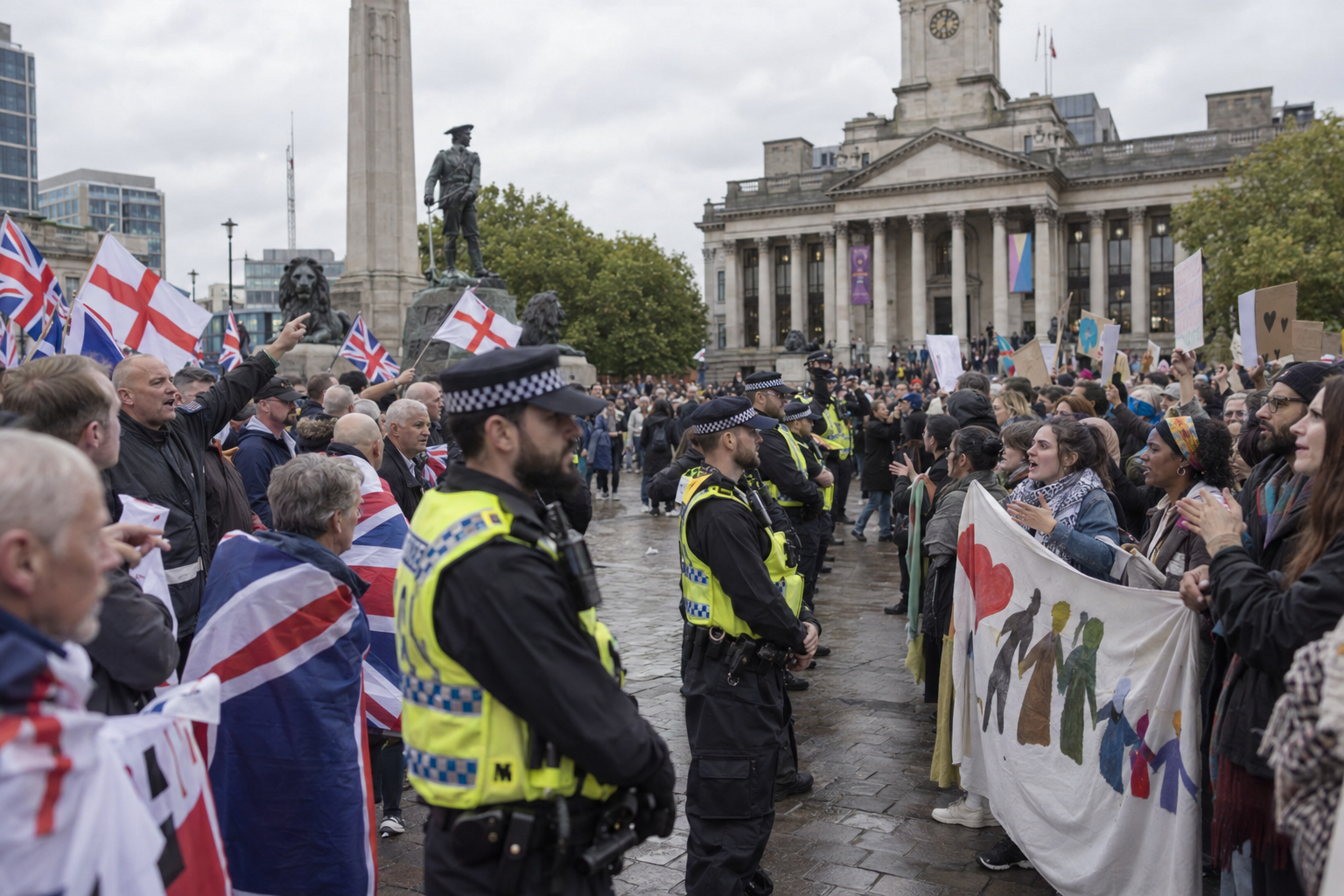
Hundreds of anti-immigration demonstrators and anti-racism campaigners confronted one another in Portsmouth on Saturday, turning the centre of the south-coast city into a tightly controlled arena for Britain’s increasingly bitter argument over migration. Police officers formed lines between the groups in Guildhall Square as rival chants, flags and placards filled the space. The rallies were mostly contained, but tension followed the crowds when sections began to disperse.
The anti-immigration march drew people carrying Union flags and St George’s flags, with chants demanding an end to small-boat crossings. Across the police cordon, supporters of Stand Up To Racism held Refugees Welcome banners and signs praising the Royal National Lifeboat Institution. The RNLI has faced abuse from anti-migrant activists for rescuing people at sea, making its work an unusually prominent symbol in Saturday’s exchange.
Both demonstrations moved through parts of Portsmouth before gathering on opposite sides of Guildhall Square. For several hours, the confrontation was loud but largely static. The situation changed as the anti-racism rally left. Around 100 anti-migration demonstrators broke away and followed counter-protesters through nearby streets, according to reporters at the scene. Officers moved with the groups through side roads, where scuffles and shouted abuse created a more difficult, mobile policing operation.
Hampshire and Isle of Wight Constabulary had imposed conditions determining where each group could assemble. It also used new powers under Section 158 of the Crime and Policing Act to prohibit face coverings intended to conceal identity in a designated area. A separate Section 60AA authority allowed officers to order the removal of disguises. The restrictions followed violence and intimidation during the previous weekend and applied to everyone taking part, regardless of political allegiance.
Police reported three arrests connected with Saturday’s operation. A 76-year-old man from Southampton was detained on suspicion of concealing his identity at a protest. A 33-year-old Portsmouth man was arrested on suspicion of obstructing the highway and criminal damage. Officers also arrested a 16-year-old boy on suspicion of violent disorder, although that allegation related to the previous Sunday’s unrest at Eastney Marina rather than the rival rallies in the city centre.
The weekend carried the memory of that earlier disorder. On 6 September, about 200 anti-immigration activists gathered at Eastney Marina after a boat carrying asylum seekers arrived on the coast. Seven officers were injured, though none seriously, and Coastguard and Border Force vehicles were damaged. Police have since reviewed hundreds of hours of footage, charged one man and released images of six others they want to identify as part of the investigation.
That background gave Saturday’s face-off significance beyond the number of people present. Portsmouth has become a visible point in a wider dispute about Channel crossings, border enforcement and the language used about asylum seekers. Anti-immigration participants said they wanted the government to stop unauthorised arrivals. Counter-protesters argued that concern about policy was being turned into hostility towards refugees and the volunteers who rescue them. Each side described its presence as a defence of the city, leaving police to protect the practical boundary between speech and intimidation.
The day’s contrasting images captured that argument: national flags on one side, refugee-solidarity signs on the other, and fluorescent police jackets in the middle. They also showed how quickly an organised rally can splinter once marchers leave a controlled square. A fixed cordon can separate two crowds; it is far harder to maintain that distance when smaller groups move through shopping streets, car parks and residential roads.
Police and crime commissioner Donna Jones said the protests ended without a repeat of the serious scenes at Eastney Marina. She described the gathering as peaceful apart from the actions of a few people and noted that most participants complied with the requirement to uncover their faces. The force said it would support lawful protest while acting against people seeking to create fear or provoke violence.
For Portsmouth, calm was preserved but not comfortably. The arrests, the brief pursuits and the heavy police presence showed a city managing pressure rather than escaping it. The deeper dispute remains unresolved: how Britain controls dangerous crossings, treats people who reach its shores and protects public debate from sliding into collective blame. On Saturday, those questions did not stay in Parliament or on television. They occupied the same square, shouted across a line of officers, and then spilled into the surrounding streets.