
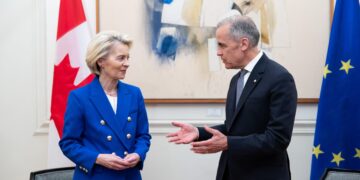







































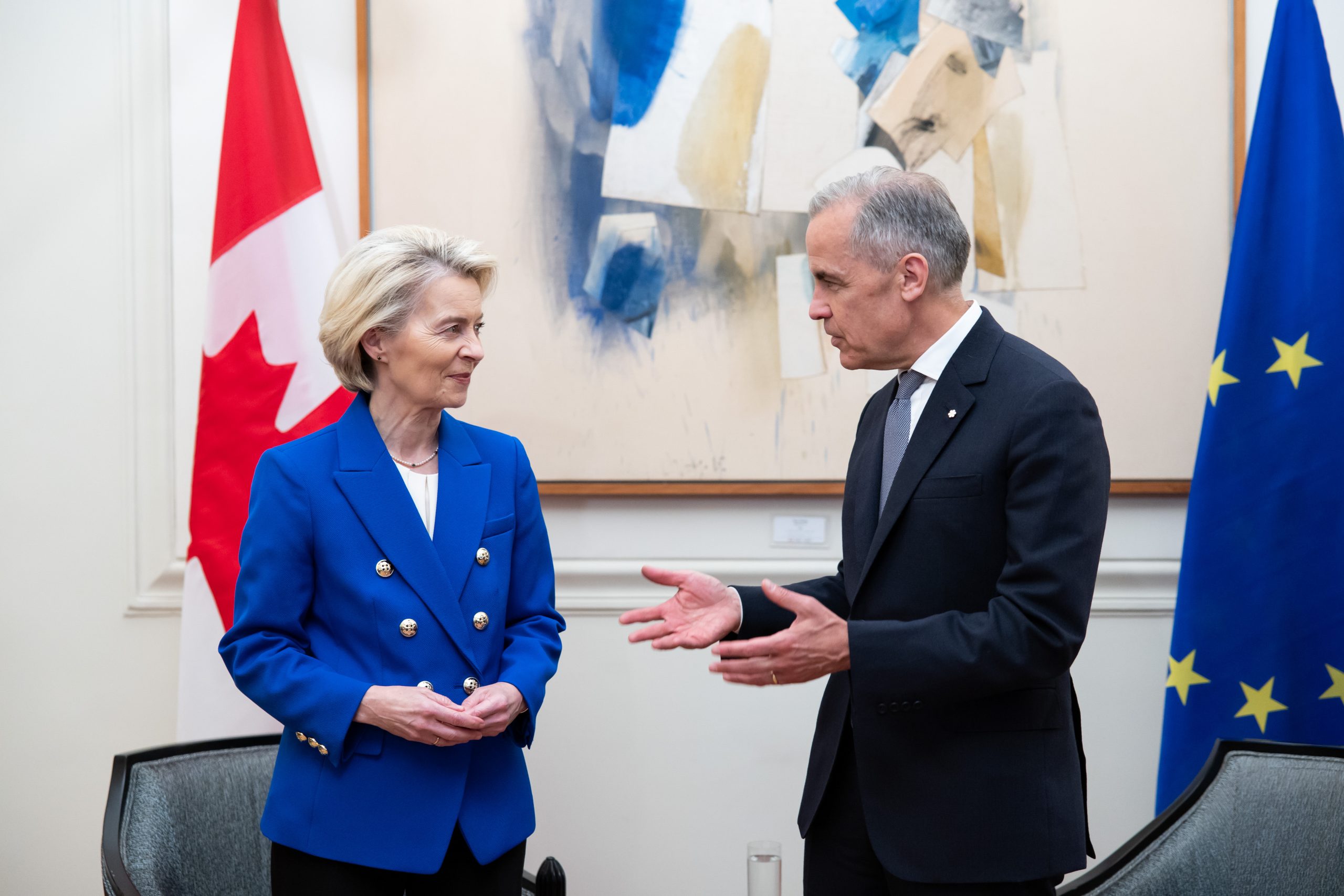
For a country that has spent more than a century defining itself in relation to its enormous southern neighbor, the sight of Canada’s prime minister rising to applause inside the European Parliament this week carried a symbolism that went well beyond diplomatic theater. Ursula von der Leyen, the president of the European Commission, used her annual State of the Union address in Strasbourg to invite Canada to become the European Union’s first ever associate member, a status that does not yet exist anywhere in the bloc’s treaties. The gesture, warm and unscripted enough to end in an embrace, was the clearest sign yet that Ottawa’s monthslong courtship of Brussels has moved from quiet diplomatic murmurs into open political theater.
The timing explains the urgency. Canada’s relationship with Washington has curdled since early last year, when renewed tariff threats and a bruising round of trade brinkmanship replaced decades of relatively predictable cross-border commerce. Talks between the two governments broke down last month, triggering tit-for-tat tariffs that have rattled manufacturers, energy exporters, and auto-sector workers on both sides of the border. Prime Minister Mark Carney, a former central banker who has built his political identity around economic steadiness, has responded by promising to double Canada’s non-American trade within a decade. Europe, eager for reliable partners in critical minerals, artificial intelligence, and clean energy as it navigates its own uneasy relationship with Washington and wary competition with Beijing, has proven a receptive audience.
Yet the phrase ‘associate member’ is doing a great deal of work for a concept that remains almost entirely undefined. Officials in Brussels and Ottawa have offered differing accounts of who even proposed the label first, and the European Commission has been careful to note that full accession is not on the table, if only because EU treaties restrict membership to European states. What negotiators are actually exploring, according to people familiar with the talks, is something closer to a deeper version of arrangements the bloc already has with Switzerland or, since Brexit, with the United Kingdom: preferential access to the single market in strategic sectors, participation in programs like Horizon Europe research funding and the Erasmus+ exchange scheme, and eventually the free movement of workers in industries tied to energy, batteries, and defense.
None of that would be trivial to negotiate, let alone ratify. The Comprehensive Economic and Trade Agreement, the deal that already eliminates tariffs on the vast majority of goods traded between Canada and the EU, offers a cautionary tale. Nearly a decade after it was provisionally applied, roughly a third of the bloc’s member states still have not completed the domestic ratification needed to bring it fully into force. Any new, more ambitious framework would require unanimity among 27 governments, several of which harbor their own reservations about extending preferential access to a non-European economy at a moment when European farmers, steelmakers, and labor unions are already anxious about competition and about immigration politics closer to home.
There is also a legal question that Brussels cannot simply wish away. Article 49 of the Treaty on European Union limits formal membership to European states, a bar that has been enforced before, most notably against Morocco’s application decades ago. Association agreements, negotiated under a different treaty article, can create extensive cooperation without conferring membership rights, but inventing an entirely new tier, positioned somewhere between an outside trade partner and a full member state, would set a precedent that other countries watching from the sidelines, including Ukraine, have already debated and in some cases resisted, fearing it could become a permanent waiting room rather than a stepping stone.
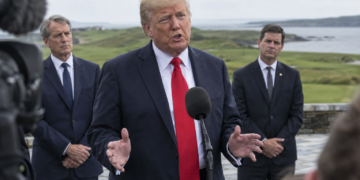
The consequences of even a partial success would ripple far beyond trade statistics. For Canada, closer integration with European markets and technology programs would offer a genuine hedge against its historic dependence on the United States, diversifying supply chains for semiconductors, batteries, and clean energy at a moment when both goals feel newly urgent. For the European Union, binding in a resource-rich, democratically stable partner would bolster its case that it can offer serious alternatives to countries wary of Washington’s unpredictability and Beijing’s assertiveness. It would also hand Brussels a rhetorical win over President Trump, whose talk of Canada as a ’51st state’ has become a running irritant in Ottawa.
But the risks of overpromising are real. Should the associate member concept collapse into another slow-moving negotiation, or shrink into a modest expansion of existing research and mobility programs, the political letdown in both capitals could be sharp, particularly for Mr. Carney, who has staked considerable credibility on delivering tangible alternatives to American trade. Detailed talks are expected to begin at a Canada-EU summit in Montreal in late October, when the distance between Wednesday’s applause and an actual, workable agreement will start to become clear.