










































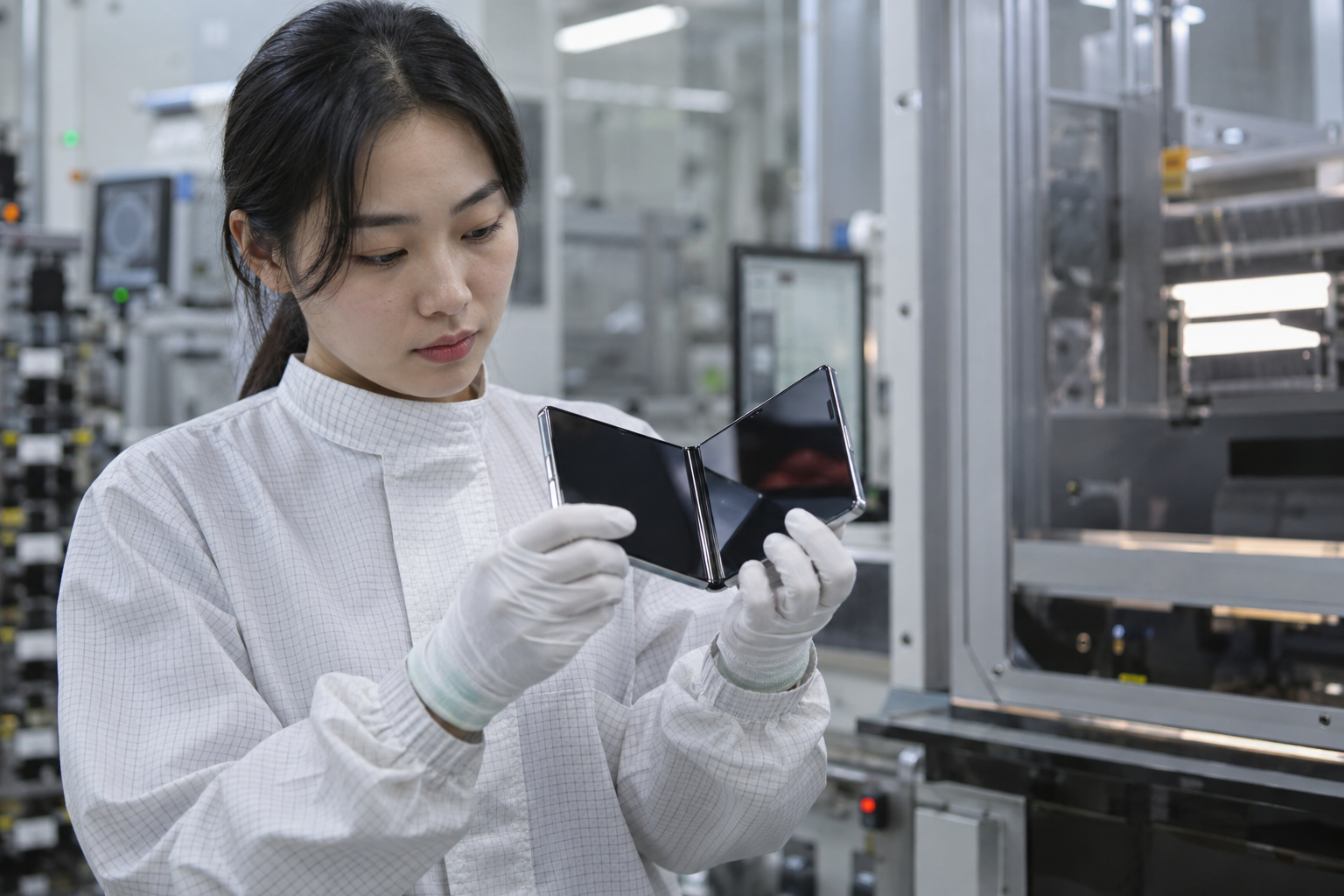
Apple likes to present the iPhone as the purest expression of its own judgment: silicon designed in California, software tuned behind closed doors, and hardware refined until every seam seems inevitable. Its first foldable complicates that story. More than any recent iPhone, this device appears to depend on South Korea not simply for parts, but for the practical knowledge required to make an unfamiliar category feel finished. The fold may carry an Apple logo, yet much of the confidence behind it was earned in Korean factories.
That distinction matters. A normal premium phone can spread risk across mature suppliers because its hardest problems are well understood. A foldable concentrates risk in the screen, hinge, supporting plate, flexible circuitry and ultra-thin layers that must survive years of repeated motion. These pieces behave as a system. A microscopic change in stiffness can alter the crease; a slightly different adhesive can affect durability; a hinge tolerance can change how the display looks when open. Apple cannot manage those interactions through specifications alone. It needs suppliers that have already watched millions of devices bend, age and occasionally fail.
Samsung Display therefore occupies a position far more strategic than that of an ordinary screen vendor. Industry reports have consistently placed it at the center of Apple’s foldable OLED supply, drawing on experience accumulated through Samsung Electronics’ Galaxy Fold and Flip generations. This is the delicious contradiction at the heart of the product: Apple’s most direct premium-phone rival may also be the company that makes Apple’s biggest hardware departure possible. Competition at the storefront is being underwritten by cooperation deep inside the device.
The Korean role also radiates beyond the panel. Companies linked by reporting and analyst expectations to the broader foldable supply chain include BH in flexible printed circuits, Duksan Neolux in OLED materials and Fine M-Tec in display-supporting backplates. Established Apple partners such as LG Innotek, Samsung Electro-Mechanics and SK hynix add strength in cameras, substrates and memory. Not every rumored contract deserves to be treated as settled fact. Still, the pattern is clear: the closer a component sits to the foldable’s mechanical and visual identity, the harder it is to separate Apple’s design ambition from Korea’s manufacturing ecosystem.
Korea’s greatest contribution may be invisible: institutional memory. The country’s foldable industry has lived through cracked review units, protective-film confusion, dust vulnerability, thick bodies and conspicuous creases. Those episodes were embarrassing, but they were also expensive experiments that produced process data, inspection methods and supplier habits. Apple is arriving late enough to inherit the lessons without paying the full public price for learning them. In that sense, it is not outsourcing innovation. It is purchasing a compressed history of failure.
This dependence creates an unusual inversion of Apple’s usual power over suppliers. The company can negotiate fiercely on volume, yield and cost, but credible alternatives are limited when the requirement is a thin, durable, nearly crease-free folding display made at iPhone scale. For conventional OLED panels, Apple can encourage competition among Samsung Display, LG Display and China’s BOE. At the frontier of foldable OLED, that bargaining triangle narrows. The supplier with the deepest production record gains leverage, even when Apple writes the design rules.
There is risk in that concentration. A yield problem in one Korean production line could become an Apple launch problem. Diplomatic friction, export controls or a dispute over intellectual property could travel quickly from the peninsula into Cupertino’s product calendar. Apple will almost certainly cultivate second sources over time, because diversification is part of its operating discipline. Yet a second source on a spreadsheet is not the same as a second source with years of tacit knowledge. The first generation is where dependence will be most intense, because there is the least room for a substitute that is merely good enough.
That is why this iPhone should be read as more than Apple entering a fashionable form factor. It is a demonstration that supply chains do not merely execute innovation; sometimes they define which innovations are commercially available. Apple will control the interface, the industrial design and the story told onstage. Korea may control whether the crease disappears, whether the hinge feels trustworthy and whether production yields support a global launch. If the device succeeds, Apple will deserve credit for turning a fragile category into a coherent product. But the deeper achievement will be shared: California may author the experience, while Korea makes the fold believable.